1.
Zofia Plaszczewska b. 16 March 1904 in Wilno, the St Rafal parish, the blue-gray eyes, married on 07 September 1924 in Wilno to Jerzy Konstantynowicz aka Marian Stankiewicz vel Marian Konstantynowicz/Yuri Konstantinovich b. 23 April 1898 in Tallinn or April 1897 in Tallinn, Ortodox, and named Zofia Konstantynowicz moved home in 1924 to Lida, the 77th Infantry Regiment's garrison till 15 September 1939; since 22 September 1939 in Wilno, on 22 February 1945 moved home to displaced persons camp close to Grodno, since May 1945 in Lodz, the Kosciuszki Str with help of the Andrzejak family, died in August 1987 in Lodz - her son Edward Gwidon Konstantynowicz was killed in the same home at the corner of Skladowa Str/Kilinskiego Str by Wojciech the counter-intelligence agent on the night 02/03 November 1987.
2.
Jerzy Konstantynowicz b. in 1897 in Tallinn, with false data: b. in Miezonka on 23 April 1898, or in Pogost/Pohost close to Berezyna, either in Warsaw in 1898, or in 1900 in Miezonka, with foster parents - Stanislaw Konstantynowicz the owner of Miezonka + Anna Malkiewicz; Jerzy was the son of Wiktor Konstantynowicz b. 1874 in Kazan + Staroch-Siedoch/Starykh-Siedykh of Kazan, the grandson of General Wasyl Konstantynowicz + Dss Maria Trubecka b. ca 1842 in Cracow, the great-grandson of Maria Kalinowska Css, Dominik Konstantynowicz b. ca 1800 + Oktawia Piottuch-Kublicka 1-voto Szumska with her roots from Duke Stanislaw Radziwill b. 1722.
Named Jerzy Konstantynowicz or Marian Konstantynowicz has scare under knee, the 'A' blood group, only 160 cm (in 1942), Colonel of intelligence with the Colonel uniform in the morning of 18 September 1939 as Colonel Piotr Siedlecki then in Grodno, Zawiasy, Palanga, the Kola Penninsula, Arkhangielsk, the General Anders Army, Cassino battle in 1944, after June 1944 till Spring 1947 in Italy; then in Buenos Aires in 1947-1953, Berisso/La Plata close to Buenos Aires in 1954, after 1955/1956 in Mexico. Jerzy Konstantynowicz aka Marian Konstantynowicz was Polish soldier on 04 December 1918 in Lapy, then Zambrow, Wilno in December 1918/January 1919, and he was soldier till 01 May 1947 in Genua in Italy. He was in Genua and Rome till November 1947.
My father Edward Gwidon Konstantynowicz [the son of Colonel Stankiewicz, aka Marian Konstantynowicz, born Jerzy Konstantynowicz not in 1898/1900, but in Reval / Tallinn in 1897 or on 23 April 1898 in Reval] was murder on 02/03 November 1987. This is connected to the ILLUMINATI and TEMPLARS linked to Miezonka owned by Stefania Julia Radziwill Oskierka Chrapowicka and with the Konstantynowiczs in 1842-1918, the net of Wiktor Konstantynowicz in Estonia and to his brother Apollon Konstantynowicz in Moscow; in the background of these events we have the 'Nadberezyncy' book of Florian Czarnyszewicz on Woncza, Borki, Smolarnia close to Bobrujsk; Wankowicz in Swolna and Kaluzyca; Slotwinski and Koziell-Poklewski in Rawanicze; Szostak in Huta close to Berezyna and in Miezonka. My grandfather Jerzy Konstantynowicz with nickname Colonel Marian Stankiewicz b. not in 1898 or in 1900, but in Reval / Tallinn in 1897, was the son of Wiktor Konstantynowicz or Wiktor Konstantynowicz Staroch Siedoch [aka 'Staroch Siedoch' / Sedykh, nickname at his tomb: 'Konstantyn'] born on 20 October 1874 in Kazan; the grandson of General Wasyl Konstantynowicz of Kazan b. ca 1834/1840 + Mary vel Maria nee Trubecki / Duchess Mary Trubetskaya / Maria Trubecka / Trubetskaja / Trubetzkaya born ca 1842 in Cracow. The great-grandson of Dominik Konstantynowicz b. ca 1800/1805, the landlord of Miezonka in 1842.
Bogdan Konstantynowicz's grandfather Jerzy Konstantynowicz aka Marian Stankiewicz/Marian Konstantynowicz knew very well spoken and written Estonian (Jerzy/Yuri Konstantynowicz was born in April 1897/April 1898 in Tallinn as Ortodox, 160 cm, scar under knee, studied in Mohylow by the Dniepr river in 1907, then in Parnu/Parnawa's Boys College in 1908-1912, his sister Galina Konstantynowicz married Heinrich Dunkel who was killed in Tallinn by communists) according to the Polish Ministry of Defense in Warsaw - and he studied at
the Naval Corps (or at the Petrograd Naval College = the Naval War College/Naval Academy; Course of Navigation Officers 1912 - December 1916) in St Petersburg (Jerzy's father Wiktor Konstantynowicz was living in St Petersburg in 1912) and
he first served in the Kronstadt Stronghold (the Bureau of Navy Transport - in a navigation ensign capacity, i.e. concretly "pra'porchik", this is a temporary rank, about equivalent to Sub-Lieut., R.N.R. in British Navy, one 1/2-inch gold stripe without curl - Dec. 1916 / March 1917).
After the March (1917) Revolution and during the First World War Jerzy Konstantynowicz / Yuri Kanstantinovich escaped on powerboat from the Kronstadt Stronghold to Tallinn (Reval = Revel, the capital of autonomous Estonia = Estland since March 1917) with Estonian engineer Jansen / Jannsen and stayed here since 02nd April 1917 by 02nd June of 1917;
Jerzy Konstantynowicz was next in Petrograd on 03rd June 1917 by November 1917.
Curiosity: 1. Among seamen writers was Captain 2nd rank Konstantin Konstantynowicz.
2. 1907 - first plant in Estonia built to provide power for household electric power on stream in Parnu.
3. 1908 - first radio transmission station in Estonia is built at the Russian imperial Baltic Fleet's Tallinn port.
During the struggles between the "whites" and "reds" after the Bolshevik Revolution towards the end of 1917 (Minsk Litewski - Jerzy Konstantynowicz / Marian Konstantynowicz has been assigned on 11 December 1917 to the Cadet Legion, here in December 1917 - and at a later date in Orsha / Orsza [Christmas?] and ca 15 December 1917 in Old Bychau / Bychow)
by summer 1918 my grandfather 'Marian' or Jerzy Konstantynowicz / Yuri served for secret service of counter revolutionary White 1st Polish Corps under general Jozef Dowbor Musnicki (a scout troop of the 1st Division and next - on 27th January 1918 - under command of engineer Wroblewski
- who later worked in an armoury in Pionki in the thirties of the 20th century keeping in touch with the Wankowicz family still - recognized Mahileu and Babrujsk)
and my grandfather fought
(Orsa = Orscha / Orsza, colonel Frej 16/20 January 1918
and Rahacou / Rochaczow on 03rd/10th January 1918 - 4th infantry regiment, the 1st Division of Polish Rifles,
Hradzianka / Grodsjanka / Grudzjenka - North of Ossipowitschi Mahilyow google satellite maps)
against the Bolsheviks for freedom of this country; he carried out duties of courier (Minsk, Babrujsk, Barysau) for the Polish Women Rings.
We must back now to Aldona nee Dzierzynski who was living in the Bobruisk district near by Ryszard Edward Wincenty Dzierzynski b. 1817, who was brother of Edmund Dzierzynski b. 1829 or (date of birth is mistake maybe) Edmund Rufin Iosifovich Dzierzynski, b. on 15 May 1838, died in 1882 (born in Oszmiany / Oshmiany, the Wilno governorate).
Then my grandfather Jerzy Konstantynowicz, the son of Wiktor Konstantynowicz of Kazan, was served to the Civil Guard of the Minsk Government and the Government of Mahileu on 08th July 1918 (all Guards in Belarus under command of General Wejtko)
- then met the family of Wankowicz in Old Kaluzyca = Kaluzyn because Mr. Witold "Tolo" Wankowicz was the chief of the Union of Weapon in the Ihumen district - autonomous section of the Polish Military Organization
- and my grandfather was courier between the Luboszany (= Libuschany of the Potockis) estate and Kaluzyca in fall 1918;
see: Berezyna; at my webpages you can to acquaint with information about former Ihumen district and with data on the Polish in the parish of Berezino; it's a large part devoted to Polish senior officers in Tsarist Army and which next served for the 1st Polish Corps in Belarus in 1917 - 1918;
Jerzy Konstantynowicz vel Marian Konstantynowicz, my grandfather was near to general Wejtko (ensign of orderly in Minsk and Vilna 1918) in the Self-defence of Lithuania and Belarus - on 22nd November 1918 from Minsk Litewski to Wilno / Vilnius,
and 04th December 1918 in Lapy close to Bialystok to Polish Army -
on 15th December 1918 a school of the Kowno Regiment
- after the collapse of tsarist Russia, Poland regained its independence after 123 years of foreign rule and he was professional officer in the military intelligence service of Polish Army (namely IInd Bureau of the General Staff - determination according to "The Secret Story of SOE (...)" by W. J. M. Mackenzie, U.K. 2000, p. 312;
on 04 December 1918 he owned document in Marian Konstantynowicz name but he wasn't this person surely over military service in voluntary Lithuanian - Byelorussian Division) 1918 - 1947;
military oath in Vilna on December 29th, 1918 during defense of the town against Soviet troops;
Marian Konstantynowicz served of the 77th Kovno Regiment next; Marian Konstantynowicz (previous Jerzy Konstantynowicz born in Reval / Tallinn) served when Poland was fighting with the Bolsheviks in defense of its independence (on 20 February 1919 battles in Rozanka, Slonim, Nowogrodek; in Minsk Litewski since 11 March 1919 to 10th May 1919; and then May 1919 till June 1920 in unknown place; but his father Wiktor Konstantynowicz served of the North - Western Army of White movement enlisted on May 20, 1919 and in December 1919 at the headquarters of the 4th Infantry Division. And Franciszek Konstantynowicz of Borowina / Borowica served the Balachowicz troops in 1919 -1920).
The LIDA garrison
(the barracks had name of Marshal Edward Rydz Smigly; the 77th Infantry Regiment handed over an estate to the Marshal west of Lida near by a farmland of famous Pilecki family;
a pilot and the pioneer of Polish air force Witold Worbek Lettaw from Lithuania (the Lettowt family was verified in the Kaunas government in 1844 - 1847 and in Vilna on 03.05.1827 as Letowt; also as Letovt Vorbek or von Lettow Vorbeck, v. Lettow-Vorbeck, Lettow von Vorbek) acted in this garrison)
by morning 18 - 09 - 1939; my grandfather at the night 17 / 18 September 1939 co-organized burning of the LIDA garrison's documentation and next was in Landwarow (= Lentvaris) on September 19th, 1939, ZAWIASY, probably arrived at the Rudziszki (= Rudiskes) station and to Grodno 20th September 1939. He gone on Lithuania on September 21st (= Litauen; was interned and after registered at the Vievis station 21st September 1939) 1939;
he was in camps for prisoners of war in: Palanga, relocated to Vilkaviskis in Lithuania, the Ponoj camp in Soviet Union (= Ponoi in USSR, by 'Karta'), Archangel / Archangelsk and moved to Viazniki / at the Wjasniki station (here in August 1941; that is the Jusha camp = Jusk of the POW camp); in September 1941 - May 1947 Army of general Anders. In 1947 emigre from Italy to ARGENTINA, La Plata and Berisso. He lived after (since 1955/1956) in Mexico, too and left one son. I am unclear about where he died; he used pseudonym Marian Stankiewicz / Antoni Stanislaw Stankiewicz (since 1919 outside of Lida); and Piotr Siedlecki in Grodno in September 1939, as though a second surname (in Siedlce was living the Stankiewicz family closest to Zofia Konstantynowicz nee Plaszczewska of Wilno).
My grandfather Jerzy Konstantynowicz aka Marian Stankiewicz was rarely at home before The Second World War. He traveled often for longer. With these expeditions brought particular trophies. What it was? These trophies from the trips were the Bolshevik guns called "revolver" or "Nagan" with a large caliber. He had a drawer in his office in the garrison of the 77th infantry regiment in Lida, full of them always. Probably, he killed enemies acc. to my father, on behalf of the Polish state. So my father spoke to us, grandfather often had to be on a secret trip to the Soviet Union. When he left the garrison and was in the central Poland, it received the nick-name Stankiewicz. For his interlocutors he took as a gift the Bolshevik guns. Once he was at the anniversary meeting of the members of the Polish Military Organization in Krakow and he was wearing a colonel's uniform. He had several biographies: according to one worked for the mobilization department of the Ministry of Defence. According to another legend, was a accountant. Still other data said that already in Tsarist Russia was learning to future employee of military intelligence, probably in the range of encryption and radio. The course includes swam on the Russian battleship - "Petropavlovsk". During World War I it was stationed in Helsinki. In 1918, in Miezonka and Bobruisk he walked in uniform of the tsarist army probably "junker", very decorative, according to his colleague from Miezonka. Also he used the birth certificate of Marian Konstantinovich, who died shortly after birth, but he was baptized. The new born baby died when his mother Anna also died - she was from the home of Malkiewicz family.
These false documents indicated to Stanislaus Konstantynowicz as his adoptive father.
When in 1939 he was in a camp for Polish interned soldiers in Palanga, Lithuania has used for identification in contact with the family, a sailing ship picture. My grandfather Jerzy or Marian Konstantynowicz had closest family in Jekabpils in Latvia, Siedlce in Poland, Viljandi in Estonia in 1930s.
In 1947 Marian Konstantynowicz settled near to Buenos Aires, Argentina.
Acc. to KONSTANTYNOWICZ Immigration Records on the Port of Buenos Aires in Argentina, at www.hebrewsurnames.com/ we read:
KONSTANTYNOWICZ, JAN aged 25, ORTODOX, Polish, on 01/02/1929 arrived to BUENOS AIRES;
KONSTANTYNOWICZ, MARIA aged 57, householder, Catholic, from Italy, ship EMPIRE HALBERD, dep. GENOVA, arrived on 20/11/1947 to BUENOS AIRES, was born in ROMA in 1890;
KONSTANTYNOWICZ, MARIAN aged 47, Catholic, Polish, ship EMPIRE HALBERD, dep. GENOVA, arrived on 20/11/1947 to BUENOS AIRES, born in MIEZONKA in 1900;
KONSTANTYNOWICZ, STEFAN aged 22, Catholic, Polish, from CHERBURG, arrived 03/08/1927 to BUENOS AIRES, born in ZYDOWSKIE; and again
KONSTANTYNOWICZ, STEFAN aged 28, from TRIESTE arrived on 18/09/1932 to BUENOS AIRES, was born in ZYDOWSKIE. These data were obtained from www.cemla.com.
My grandfather Jerzy/Yuri/Marian Konstantynowicz served intelligence unit of the White Corps in Belarus under General Jozef Dowbor-Musnicki among others in Mohylow by Dniepr river.
Jerzy's foster parents: Stanislaw Konstantynowicz + Anna Malkiewicz. In 1990s Bogdan Konstantynowicz was talking about Anna Malkiewicz Konstantynowicz with Izabella Malkiewicz Horodecka in Warsaw.
Izabella Malkiewicz born 01st May 1908 in Moskwa / Moscow / Moscou; Mother-in-God was Maryla Koziell Poklewska / Maryla Koziell Poklevski married to Slotwinski / Slotvinski. Her sister Irena Malkiewicz, actress. In Moscow her father had a car; she known very well French language. In 1911 first time in Swolna Stara, to Zarakowski, Konstantynowicz and Malkiewicz families. 1912 and 1913 in Stare Zaborze / Zaborze, close to Swolna. 1913 in Oswiej / Osvieja, in empty palace. 1914 in Rawanicze to Slotwinski family, the Berazino parish.
Izabella Horodecka Malkiewicz known Miezonka and history about Anna Malkiewicz married Konstantynowicz; Anna died when was born first baby. Lived in Moscow to September 1918; October 1918 in Wilno / Vilnius. January 1919 Vilna / Wilno was captured by Bolshevik troops, and Jozef Malkiewicz left under Soviets. The Malkiewicz family escaped to Warsaw. 1937 served the Red Cross in Warsaw. September 1939 served Field Hospital No 104 of Colonel Szarecki; 08 September 1939 left Warsaw.
Maryla Koziell Poklewska / Maryla Koziell Poklevski married to Slotwinski / Slotvinski. Born ca 1880?
Weryho either dukes Veryha, Veryha Darowski according to Kojalowicz, or Veriho - Darevski / Dareuski i.e. Verigas of Sreniawa / Szrzeniawa coat of arms in the Vicebsk A.D. 1420 and Polack provinces, also in Tver government in Russia; e.g. Franciszek Veriho - Darevski (i.e. Darewski Veryha who was an officer in Polack A.D. 1754) married Rozalia Koszyc, and next his daughter married Tadeusz Koziell Poklewski, the son of Michal Koziell Poklewski from Holowczyn i.e. Haloucyn = Holovsin 17 km NE of Bjalynicy.
Adam Wolowski (1855 to August 1865) and then Stanislaw Pusch were the directors of the Warsaw mint; that is Adam Ernest Wolowski / Adam Wolowski junior, b. ca 1798, died 1868 - Warszawa. He married ca 1820 to Barbara Maryewska, 1796-1863;
his son: Wladyslaw Jozef Ludwik WOLOWSKI, 1829-1895 + Jozefa Teofila Szymanowska, 1833-1875;
with son
Adam Franciszek Gabriel Wolowski, 1856-1900,
m. 1st Maria Koziell-Poklewska, 1860-1891,
2nd to Pss Stefania Woroniecka 1860-1925.
3.
Piotr Golec, b. on 04 March 1904, in Lodz, the Wieckowskiego Str. The blood group 0 Rh+; bright black hair, blue eyes, in 1915-1918 in Wola Pszczolecka, in 1921 he was working for 'Brothers Klos'; in 1932 the private business, then private 'Gerlach' shop confiscated in June 1943 by Germans, in Summer 1944 Piotr Golec hid himself. Piotr Golec in Lodz co-operated with August Kobylanski in 1930s-1940s in Kuznica Drzewicka. The Kobylanskis were closest relatives to Wladyslaw Mieczkowski and to the Rakowiecki-Ostrowski line the owners of Leszno village close to Przasnysz. The Golec family and the Pfeiffers intermarried the Skura family. The Pfeiffers intermarried the Kobylanskis.
Piotr Golec was taken by Red Army on 19 September 1939 east of Lwow close to Krasne, served the 'Dubno' unit and fought against Soviet Army 17-19 September 1939, died 20 October 1984 in his home in Lodz - this home was confiscated by soviet counter-intelligence in 1949 and here was sent Halina Jawors. b. in Leszno village as Halina Wodkiewicz, semite, and her great-grandson was living at Krokusow. 57 in Lodz, ca 2015 at Learoyd 1, then at Wi. 137 second floor with his friends of Pieniny 20 in Lodz/Burngat. 17/Tatna. 1B/Winterbourne 45, the friends of T. Cieslak of Krokusow. 72A in Lodz.
My family Golec-Kiedrzynski of Bieganin, Raszkow, Orpiszewek close to Pleszew, also of Kalisz and Kamyk-Kiedrzyn near Czestochowa, moved home to Jedlno, Wola Wiazowa, Wola Pszczolecka and to Lodz and here they intermarried in 1954/1955 to the Konstantynowiczs of Miezonka, Babianowszczyzna/Buhta near Minsk of Belarus, Kazan, St Petersburg, Tallinn, Nomme and Viljandi in Estonia, aslo in Lida and Bydgoszcz. My relatives Kasper Golec lived in Nieczuj and Wielun.
My ancestor Mateusz Golec b. 1836, was the son of Gabryel Kiedrzynski, and Mateusz had two children or more:
1. Elzbieta Golec b. 1863, in Wola Wiazowa, godparents: K. Banasiak and Agnieszka Zygmunt;
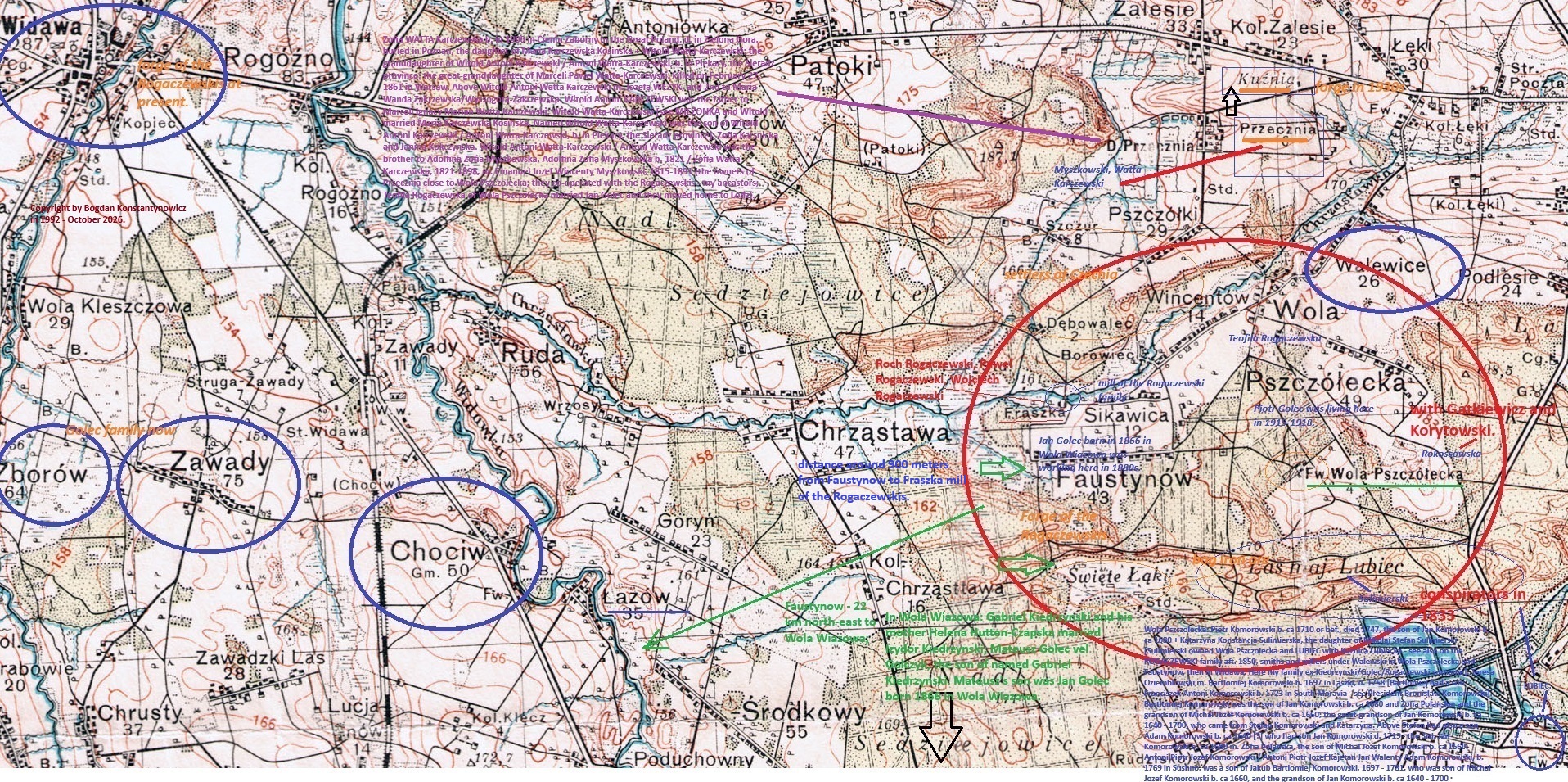
2. and Jan Golec, b. 1866, or 1867, in Wola Wiazowa, lived in Faustynow (near Wola Pszczolecka), together with the settlers of Czechia; died in Lodz, m. 1893 to Teofila Rogaczewska b. 1870, in Wola Pszczolecka the Wygiezow parish, in 1920-1950 she visited Wola Pszczolecka and Faustynow, died in December 1957 in Lodz, Jan Golec died on 08 December 1907 in Lodz.
Jan Golec b. 1866, and he had children:
1. Jan Golec junior b. 1893, d. 1893 in Buczek close to Zelow (the Rogaczewskis lived in Buczek-Zelow area);
2. Stanislawa Golec b. 1894 in Buczek, m. two times, d. in Lodz in 1959;
3. Jozef Golec b. February 1897 in Wola Pszczolecka, in 1915 served the 'Legiony'/Legions of Pilsudski, m. two times, d. in Lodz in 1959;
4. Franciszka Golec b. 1899, in Lodz, m. Stanislaw Madejski b. 1903, d. 1967, and Franciszka Madejska d. 1986;
5. Anastazja Golec, b. 1902, or 1901 in Lodz, 1-voto Palaszewska, 2-voto Puzanista, d. 1973 in Lodz;
6. Piotr Golec, b. March 1904, in Lodz, lived in 1915-1918 in Wola Pszczolecka, in 1932 the owner of his own sheet metal company, until 1943 he owned 'Gerlach' shop in Lodz, in 1947 built his home but in 1949 it was confiscated by semitic-communist court and in July 1955 Halina Jaworska settled in our home, and Piotr Golec died in October 1984, he was anti-communist, pro-German nationalist persecuted in 1949 till his death in 1984 by the Lodz counter-intelligence; Piotr Golec cooperated with the Kobylanski family in Kuznica Drzewicka, with Pfeiffer-Skora line, the Rakowiecki-Kobylanski-Mieczkowski line under influence of Wojciech Trampczynski our next of kin.
7. Bronislaw Golec, b. 1905 in Lodz, d. 1991 in Lodz, m. Feliksa d. 1992.
8. unknow Golec, the soldier of the Anders Army in 1941.
Jozef Golec b. 1897, had children:
1. Genowefa b. 1930 in Lodz;
2. Jozef Golec junior b. 1925 in Lodz, after 1941 in Germany, soldier in 1943/1944, POW of British Army in Africa, then served the Anders Army in Italy, married in Boston, UK, with Apolonia, died in 1992 in Boston -
he had 4 children:
a. Karolina Golec, lived till 1975 in California in USA, then in 1976 in Cambridge and married here for the Cambridge professor.
b. Stefan Golec, born in Boston in 1950s, UK, then in Leeds in UK, in 1976 bought home, married, he is the builder.
c. Vanda Golec, she was living in 1976 in Boston, taylor.
d. Andrzej Golec, b. 1962, Boston.
3. Kazimierz Golec, b. 1928, in Lodz;
4. Aldona Golec, b. 1950, in Lodz, married with the son Marcin Zalewski b. 1976 in Lodz, studied computers science till 1998. 5. Edward Golec, with 2 children of Lodz,
5. and Edward Golec was born in 1952, in Lodz.
Franciszka Golec b. 1899 in Lodz, m. Stanislaw Madejski, had 4 children:
a. Helena Madejska b. 1928, m. Wajszczyk, died on 16 January 1994 in Lodz.
b. Ryszard Madejski b. October 1932 in Lodz,
had son Andrzej Madejski b. December 1958 in Lodz, with a grandson Madejski b. in 1980s in Lodz.
c. Czeslaw Madejski, b. 1935, Lodz, he visited Wola Pszczolecka since 1939 till 1960s, m. 1st Hanna, m. 2nd unknown, he died in December 1993, buried the evangelic cementry. Czeslaw had 3 sons, incl. youngest b. in 1996.
d. Janina Zoltobrodzka b. April 1930, died in Lodz. Janina had 2 daughters:
Maria with one child and Elzbieta with one son.
Above Jozef Golec b. February 1897 in Wola Pszczolecka, worked in Widawa (here the Rogaczewskis), ca 1910 Jozef Golec was living in Faustynow, since 1915 served the Polish Legions together with his godfather Szczepan Rogozinski; Jozef 1st m. Bronislawa Palaszewska died in 1946 or 1947, second married to Kunegunda b. 1911, d. December 1997; Jozef died in Lodz in 1959, buried at the Rzgowska cemetery.
Jozef's older sister was Stanislawa Golec b. 13 April 1894 in Buczek close to Zelow (Buczek - 14 km north-east to Wola Pszczolecka); 1-voto Edward Kwiatkowski in 1918, b. 1890 in Wola Pszczolecka; Stanislawa moved home to Lodz in 1920, her husband died in 1944 in Germany; 2-voto Staniaszek; Stanislawa Kwiatkowska Staniaszek Golec visited Wola Pszczolecka till 1950, but the Kwiatkowskis moved out from here in 1945, and she died in 1989 in Lodz, buried at the 'Kurczaki' cemetery.
Younger sister of Jozef Golec was Franciszka Golec b. 1899 in Lodz, m. Stanislaw Madejski, b. 1903, d. 26 March 1967, they visited Wola Pszczolecka aft. 1945, and Franciszka Madejska died on 05 September 1986 in Lodz, the 'Kurczaki' cemetery close to a chapel.
Next younger sister was Anastazja Golec b. 1901 or 1902 in Lodz, 1-voto Palaszewska with German roots, d. 1940 in Lodz, 2-voto Puzanista ca 1960, and Anastazja Palaszewska Puzanista Golec died on 06 December 1973 in Lodz.
Piotr Golec b. 04 March 1904 in Lodz, the Wieckowskiego Str., died on 20 October 1984; on 07 June 1921 worked for the 'Brothers Klos' at Piotrkowska 201 in Lodz, on 20 December 1923 worked for Wladyslaw Modrzejewski, Miedziana 4 in Lodz; on 05 October 1925 served Polish Army, the 7th Sapper Unit in Poznan - October 1927; since 1932 private business, then private 'Gerlach' shop till June 1943, since 1955 worked at Piotrkowska 17, pensioner on 14 April 1969, d. 20 October 1984 in Lodz.
Piotr's younger brother was Bronislaw Golec, b. November 1905 in Lodz, lived at Tokarzewskiego 43, m. Feliksa died in November 1992 in Lodz, the godfather of my mother, d. 17 April 1991 in Lodz, buried the 'Doly' cemetery in Lodz.
So, Jan Golec b. 1866 in Wola Wiazowa + Teofila Rogaczewska born in Wola Pszczolecka had 6 children and 20 grandchildren.
Jozef Golec b. 1897 in Wola Pszczolecka had children:
a. Genowefa Golec b. 1930 in Lodz;
b. Kazimierz Golec b. 1928 in Lodz, d. 1965 in Lodz;
c. Aldona Golec b. 1950 in Lodz from 2nd wife of Jozef Golec;
d. Edward Golec b. 1952 in Lodz.
My mother had 28 cousins and distant cousins of her generation and one brother in Warsaw.
4.
Cecylia Grzanek vel Grzonek, the daughter of Agnieszka Skura vel Skora, b. 21 October 1909 in Lodz, the blood group A Rh+, the brown eyes, the very black hair, married Piotr Golec in Lodz on 27 May 1928, with two children, among others Lucjan Golec b. 30 March 1930, Colonel of Polish Army in Warsaw. Cecylia Golec died on 17 May 1985 in Lodz, buried at 'Kurczaki' cemetery. Cecylia Golec Grzanek's family intermarried in 1954 the Konstantynowiczs of Lida, Tallinn, Kazan and Miezonka. Edward Gwidon Konstantynowicz in 1940s was living in Bydgoszcz; his wife's father Piotr Golec was persecuted in 1949-1955 by the Lodz counter-intelligence established by Ajzef/Ajzen-Andrzejewski of Sawin in the Chelm Lubelski county. Piotr Golec and Cecylia Golec's private home was confiscated and here Halina Jaworska was sent from Leszno village close to Bogate and to Krasne estates in July 1955.
The fate of Moczulski, Owsiany, Bogucki, Sedzicki, Krzysztof Tomczyk, Andrzej Kolczynski, Natkanski of Honoratow, Chudzik-Cieslak of Cienia Wielka team is connected very strong to the murder of Edward Gwidon Konstantynowicz on 02/03 November 1987 (this counter-intelligence team acted around me in 1972-2026), the father of Bogdan Konstantynowicz. Bogdan Konstantynowicz's ancestors and our relatives (famous Wojciech Trampczynski whos roots came back to the Kiedrzynskis of Raszkow and Bieganin; Wladyslaw Mieczkowski whos genealogical links back to Pfeiffer, Kobylanski, Rakowiecki, Donimirski, Bialoblocki, Karwat families; the Kobylanskis of Kuznica Drzewicka intermarried Gerlach and Szaniawski families) fought against Lajb Wolf Ajzen in Sawin / Leon Andrzejewski / Leon Ajzef of the Chelm Lubelski county and his friend Izydor Kurtz / Kurc / Czaplicki of Lodz; Izrael Ajzenman in Drzewica, Lodz, Poznan that is the marxist underground under Jozef Rozanski / Jacek Rozanski / Jozef Goldberg, and with Roman Romkowski / Nasiek (Natan) Grinszpan-Kikiel / Natan Grunsapau-Kikiel / Grinszpan Menasze influenced by the Zionist movement and under the direction of Russian and Soviet military intelligence; they were creators of the Lodz counter-intelligence office in February 1945 and they persecuted Wladyslaw Mieczkowski, Wojciech Trampczynski and August Kobylanski in 1943-1959. The communists built espionage net around Bratoszewice-Glowno, Bogate-Leszno close to Krasne; Ignalina in Lithuania; Thessaloniki in Greece; Zilina in Slovakia; Sibiu in Romania; and around Kobiele Wielkie, Zakrzow Wielki and Dmenin Zakrzewski in 1944-1947; Tomaszow Lubelski and Sawin in the Lublin province. Bogdan Konstantynowicz's genealogy is linked to the Karwat family, Nostitz-Jackowski, Donimirski-Bialoblocki, Wybicki-Plaskowski, the Hutten-Czapskis, the Bardzki family, Koschembahr-Lyskowski of Tczew-Turze Male, Sumowko-Wichulec, Raszkow-Bieganin and Belarus-Kojdanow-Miezonka.
The espionage team around me in 2005/May 2026 is 4th generation of minoroties (of Lodz/Stoki-Zgierz, Wabrzezno, Tczew, Chelmza, the Opoczno county, Chocen, Brzesc Kujawski, Wloclawek, Sawin) working around
Maria Kobylanska, 1910-1990 [the sister of Bogna], m. Adam Stanislaw Ryszard Mieczkowski,
the son of Wladyslaw Mieczkowski b. 1877 in Nieciszew / Nieciszewo - d. 1959 in Barzkowice; lawyer, banker, political activist, a member of the GERMAN parliament in 1907. Wladyslaw Mieczkowski was persecuted by the Polish soviet state in 1940s. Nieciszew / Nieciszow [= Nieciszewo, in the Bydgoszcz county = Justhofen, 3 km west to PRUSZCZ, 5 km west to WALDOWO - compare LEWINSKI of TCZEW].
Wladyslaw Mieczkowski b. 1877, was the son of Stanislaw Mieczkowski, the Nieciszew / Nieciszewo estate landlord [= Nieciszewo, in the Bydgoszcz county, nearby WALDOWO and PRUSZCZ] + Helena Donimirski.
Wladyslaw Mieczkowski b. in Nieciszewo in 1877, solicitor in Poznan in 1905, Director of Bank Polski in 1924-1934, Polish conspirator, enemy of Russia. Stanislaw / Stanislaw Maksymilian Mieczkowski older, was the son of Leopold Mieczkowski + Kalkstein.
Leopold Mieczkowski, 1811-1892, and he is not Leopold Hipolit Mieczkowski b. 1833 in Ciborz close to Lidzbark- but not Lidzbark Warminski, d. in 1899 in WLOCLAWEK, buried in Warsaw.
Above named Stanislaw Mieczkowski b. 1844 in Goluszyce, the owner of Laszew / Laszewo, sold in 1882, and of Nieciszewo, the insurgent in 1864, died in 1917, buried in Serock. He married Helena Donimirska, d. in Nieciszewo in 1917.
Stanislaw Mieczkowski was the son of Leopold Mieczkowski / Leopold Maksymilian Samuel Mieczkowski,
who was the son of Engelmann Mieczkowska 1-voto Goetzendorf-Grabowski. Leopold Mieczkowski b. 1811. Stanislaw Mieczkowski was the owner of Laszew in the SWIECIE county; the owner of Stanislawice / Stanislawie close to Swiecie, sold in 1885 to Gerlach - see Kobylanski and Gerlach in Kuznica Drzewiecka with the links to Kobylanski-Rakowiecki in the Leszno village close to Przasnysz.
August Kobylanski younger was the husband of Maria Pfeiffer b. ca 1893, not in 1900. August was the brother of Maria Jadwiga Kobylanska-Bauerfeind. August Kobylanski of Drzewica had links to the village Leszno close to Przasnysz [Kobylanski-Rakowiecki; Kisielnicki-Brodzki; Ostrowski-Rakowiecki; with the Kobylanski-Mieczkowski genealogical line] and Bogate [Narzymski + Lewald-Jezierski; and Narzymski of Jablonowo Pomorskie and of Janczewo in the Wizna parish as the Kisielnicki famiy linked to the Kossak family, and to Leszno village and also to Fryderyk Chopin and Stanislaw Moniuszko, Henryk Sienkiewicz, Juliusz Kossak and his famous family]. I don't have to pretend, after 54 years of constant observation, that this is being carried out by an interstate Semitic-Marxist organization, of a pro-Russian and pseudo-liberal nature. At the lowest level, they exploit multi-generational gypsy families: Kingston 78, Kingston 75, 6, 67, 69, Dereham Way 54, Parkstone 81, Denmark 40, 23, 31, 13, Shaftesbury 9, 16, 21, Tatnam 80, 1B, 1C, 4, 31, 33, 15, 43, 113, Fernside 80, 16, 23, 17, Longfleet 43A, Denmark Ln 18, Elizabeth 2, 9, 16, 1. The whole thing has an exceptionally racist and anti-Polish character - only 80/100 buildings and 150/250 persons but at top is the Stoki district in Lodz: Skalna 15, Potokowa 21, Pieniny 20 the friends of Tadeusz Cieslak of Krokusowa 72A, Pieniny 3, 5, 2, 21, 14, 28, Zbocze 2, 12, 14, 37, 23, 15, 17, Szczytowa 17, 1, Skalna 1, Gubalowka 13, Gorska 14, 12, 17, 21, 25 flats 3 and 4, Telefoniczna 60, 61, 30, Halna 15, Spartakusa 43, Janosika 61, Krokusow. 50A, 57, 59, 55, Przelecz 4 ground flat, Przelecz 12 ground flat, Przelecz 14/Denmark 23, Przelecz 6 flat 1.
The Konstantynowicz family met the ex-Kiedrzynskis in 1947 the first time with "help" of Jerzy Kruszynski - he died in Lodz in 1970s. Then in December 1954 with "help" of the Lodz counter-intelligence Edward Gwidon Konstantynowicz married the Golec line. In July 1955 Soviet intelligence agency sent to Piotr Golec's home Halina Wodkiewicz married Jaworska; the Jaworskis intermarried the Sedzicki-Bogucki clan served communist militia in Lodz and counter-intelligence in Warsaw. Above family net met the Tarashvili family in 1990, together with Darbys Ln 99/Telefoniczna 61/Winterbourne Close 3/Garland 30, and also Pieniny 20 the friends of Tadeusz Cieslak of Krokusow. 72A, and with Elizabeth 9/Pieniny 14 in Lodz/Lodz Radio station at Narutowicza Rd - the friends of Parkstone 81/Kingston 78/Denmark 13/Shaftersbury 9, 21, also friends of Durley Garden 15, Elizabeth 16 and 2, Uplyme Close 36 = Pieniny 3 in Lodz; Pieniny 20 - the family of Skalna 15 in Lodz with friends of The Triangle 14, Tatnam 1C, Tatnam 1B.
Above Golec family never informed the Konstantynowiczs (in 1947-1987) about them surname - Kiedrzynski - and about villages Wola Wiazowa, Jedlno, Wola Pszczolecka. My research in 1992-1993 showed all about. But this is very interesting family together with Elzbieta KARWAT, 1842-1906 + Wladyslaw Hutten-Czapski, b. ca 1835/1840 [the son of Ignacy Hutten-Czapski b. 1802 in Raszkow of the Kiedrzynskis - my ancestors - Ignacy probably was fighting in 1833 and he was persecuted by Russians. Raszkow was visited by Helena Hutten-Czapska married Izydor Kiedrzynski of Jedlno, after the death of her husband Izydor. Helena's son was Gabryel Kiedrzynski who was acted in independent underground in 1819-1833 and he changed surname 5 times after January 1833. Gabryel's son was Mateusz Go. cooperated with the Pradzunskis of Wola Wiazowa; the grandson was Jan Go. married in Wola Pszczolecka to Teofila Rogaczewska died in Lodz; the great-grandson was Piotr Go. persecuted by the semitic-communist team of Ajzef/Ajzen from Sawin in the Chelm Lubelski county and Kurc/Kurz of Lodz in February 1945; the great-great-grandson was Lucjan Go. with second wife from Zelechow, he was Colonel in Warsaw; Lucjan's sister was I. Go. m. Edward].
Elzbieta's children:
A. Helena Hutten-Czapska b. ca 1870 m. Jozef Koschembahr-Lyskowski, 1853-1922.
B. Czeslawa Hutten-Czapska, 1874-1956 + Kazimierz Deutsch, 1863-1906.
C. Junior, Wladyslaw Czapski b. in 1882 in Rajsko, engineering, living in Kalisz, m. in 1911 in Dzierlin, in the Charlupia Mala (see the Chudzik family and the Lubienski landlords) parish to Zofia Brzezinska b. in 1882 in Dzierlin, the daughter of Antoni Brzezinski b. ca 1855 + Maria Kobylecka. Compare the Ordega family in Cienia Wielka where the Chudzik-Cieslak family lived in the 19th century.
The Kiedrzynskis intermarried in 1730s to the Nostitz-Jackowskis of the Koscierzyna county and of Chelmza district; in 1780s intermarried the Hutten-Czapskis of the Brodnica county. Aleksander Nostitz-Jackowski had the son Jozef Nostitz-Jackowski b. in 1767 m. Jozefina CISSOWSKA. Aleksander Nostitz-Jackowski [3rd], ca 1729 - 1802 in Nogat village; m. 1st to Dorota RADOLINSKA, 2nd to NIEWIESCINSKA, 3rd to Marcianna Antonie Barbara KCZEWSKA, b. in 1745 in Straszewo, the daughter of Andrzej Kczewski and Marianna PAWLOWSKA.
Jozef Nostitz-Jackowski b. 1767, was the grandson of Michal Nostitz-Jackowski [the brother of Anna Skorzewska and of Franciszka Kiedrzynska - my family line], ca 1700/1705 - ca 1766 + Ewa Wypczynska and Eleonora DABROWSKA.
Jozef Jackowski b. 1767 was the great-grandson of Jan Nostitz-Jackowski b. ca 1670 (my ancestor), m. twice, 1st to Teresa Zaluskowska, 2nd to Rozalia TRZEBSKA.
Jan Nostitz-Jackowski b. ca 1670 was the son of Boguslaw Nostitz-Jackowski or Boleslaw Nostitz-Jackowski, b. in 1618 or rather in 1638 in Wielka Turza, close to LIPNO + ELZANOWSKA,
the grandson of Krzysztof Nostitz-Jackowski b. ca 1590/1600 + Katarzyna Garczynska b. ca 1595/1619 in Orle close to Koscierzyna, 3 kilometres south-west of Liniewo, 17 km south-east of Koscierzyna.
Jan Jackowski / Jan Nostitz-Jackowski b. ca 1670/1680 + 3rd wife Anna Lukomski.
The Kiedrzynskis intermarried the Pradzynski family the owners of Wola Wiazowa and of Wilkowo Polskie in the 19th century.
Ludwika Pradzynska Swiniarska had the brothers:
1. Stanislaw Kostka Jozef Pradzynski, born in 1761 in Pacholewo - died in 1817, the owner of Wola Wiazowa;
and 2. Melchior Jan Pradzynski [b. 1753 in MROWINO, d. 1797, married PETRONELA KIEDRZYNSKA,
the daughter of Jakub Kiedrzynski b. 1738,
the granddaughter of Andrzej Kiedrzynski b. ca 1710 + Franciszka Nostitz-Jackowska [my ancestors],
and Franciszka was the daughter of Jan Nostitz-Jackowski + Teresa Zaluskowska, the 1st wife.
Above Melchior Pradzynski was the father of
1. Andrzej Pradzynski and
2. Jozef Pradzynski.
Named Andrzej Pradzynski, 1794-1872; born in Kowalew / KOWALEWO close to PLESZEW, 5 km east to Orpiszewek of Kiedrzynski; north-east to Dobrzyca.
Around me Bogdan Konstantynowicz ca 1990 till today in October 2026 and around my mother's ancestors acted two families and they are distant relatives to Bogdan Konstantynowicz: the Owsiany family after 1833 in the Greater Poland and the Bogucki family intermarried the Walknowskis (ca 1735), and the Bardzki family (in 1721, ca 1730) - the Bardzki and the Walknowski families intermarried the Kiedrzynski family, my mother's line. The Bogucki-Owsiany-Mielzynski-Walknowski-Wyssogota Zakrzewski branch connected my mother's genealogical line with big espionage communist team after Second World War. Andrzej Barcikowski managed counter-intelligence till November 1, 2005. Andrzej Barcikowski b. 1955 in Warsaw, the head of the State Protection Office and the Internal Security Agency in 2002-2005; in Lodz in 2002 July, the position of director of the delegation was held by Major Dariusz Pilarz. Andrzej Barcikowski was the grandson of Waclaw Barcikowski and the son of Wladyslaw Barcikowski.
Above highly dangerous, aggressive network of a pseudo Counterintelligence nature dependent on the Russians. But I had data on June 2008 - Adam Ostoja-Owsiany, was the head of the Human Resources department of the Foreign Intelligence Agency / the Civil Intelligence Agency, decided on newly admitted intelligence officers. In July 2002, Adam Ostoja-Owsiany, was the head of the Office for State Protection in Lodz; the son of Andrzej Ostoja-Owsiany, who was the friend of Rober Berman Moczulski alias Lech Robert Moczulski / Leszek Moczulski of Mariowka [and his cover].
Leszek Moczulski was the friend of Bronislaw Geremek. L. Moczulski in 2005 defended at the Academy in Pultusk a doctoral dissertation entitled Geopolitics. The supervisor was Professor Bronislaw Geremek of Dzbadz close to ROZAN.
Zbigniew Nowek was the head of UOP / the Office for State Protection in Poland; and then of the Foreign Intelligence Agency. The 1st chief of named Intelligence Agency was Siemiatkowski, and the 1st chief of the Internal Security Agency was Andrzej Barcikowski. During this period, the largest impact on special intelligence services on the Vistula province ["Poland"] had Andrzej Barcikowski (April 2002 - June 2002). Before him Z. Nowek and Z. Siemiatkowski. Then A. Barcikowski was the Head of the Internal Security Agency, from June 2002 to November 2005; his successor was Witold Marczuk [in 2005 - 2008, head of intelligence, both military and civil intelligence].
Named A. Barcikowski is a high official of the communist party, 1984-1990; trusted Prime Minister Wlodzimierz Cimoszewicz [W. Cimoszewicz is the son of Marian Cimoszewicz from Wolkowysk and grandparents during World War I came to Symbirsk, where Marian Cimoszewicz was born; Wlodzimierz Cimoszewicz's father was a professional military officer and served in 1940-1943 the Red Army in the Soviet Union and then in counterintelligence of a communist army in "Poland"].
ANDRZEJ Barcikowski is the grandson of Waclaw Barcikowski, 1887-1981, one of the most important communists under Stalinist management in Warsaw: First President of the Supreme Court (1945-1956), Deputy Speaker of the Legislative Parliament, member (1947-1952) and deputy head of the communist state (1952-1956) in the so-called Council of State. Waclaw Barcikowski came from a Warsaw; he worked at the 'Szukiert and Siemens' plant in Warsaw. Before World War I, he spent several years in Moscow [here also the fate of my family], where he participated in the 1905 revolution. In 1912 he passed the matriculation examination in Moscow, and in 1918 he graduated studies at the Moscow University. Waclaw married Antonina Balakirev. Waclaw Barcikowski in the years 1919-1924 worked as a prosecutor in Poland. Waclaw defended Wladyslaw Gomulka, then the head of Polish communists.
Waclaw Barcikowski had a son, General Wladyslaw Barcikowski born in 1916 in Merefa, in the Charkow district, Ukraine now. Wladyslaw Barcikowski in 1964 was appointed military commander Institute of Aviation Medicine [here the fate of my family, Lucjan Go.].
So it turns out that civil intelligence from several local centers in Poland [Siemiatkowski - Ananicz - Nowek under Milczanowski's support], during the communist rule of Aleksander Kwasniewski [the head of the communist student movement in the 1980s in the 20th century] + communist PM Leszek Miller [in 2001 - May 2004; the friend of Malgorzata Zieleniewska, registering premises for the installation of wiretaps until 2001. Then replaced by Monika Boguck. from the Internal Security Agency].
Teresa Kinga Bogucka b. 1945 w in Zakopane, the daughter of Janusz Bogucki b. ca 1922 + Maria Friedel.
Teresa's grandfather was Mieczyslaw Bogucki / Mieczyslaw Adam Bogucki b. 1884 in LODZ, the Russian occupation.
Mieczyslaw Bogucki was the son of Lodz railway clerk, Tadeusz Bogucki (1842-1908) + Klaudyna Przeradzki (1849-1941) - this is branch of Sporna 85 in Lodz (Monika Boguck. b. ca 1976, m. Sedzick. is the family of Jaworsk.-Wodkiewic. clan of Learoyd 1 and Krokuso. 57 in Lodz) + the Braunek family in Cracow.
Above Tadeusz Piotr Tomasz Bogucki, 1842 - 1908, bpt in 1843, had 4 siblings: Helena Hulewicz (born Bogucka - the Braunek line) and 3 others. Tadeusz older b. 1842, married Klaudyna Bogucka (born Przeradzka). They had 8 children: Wanda Eleonora Bogucka, Wladyslaw Stanislaw Bogucki and 6 others.
Tadeusz Bogucki younger, insurgent in 1944 in Warsaw, lived in 1921-1986, was the son of Bogucki, b. 1873 in SZCZAWIN [also inf. in Byszewy and Malachowice] - 1951 [also at Lodz, the Jews cemetary and The Church of the 'Sw Trojcy' in Lodz, like my mother's family in Lodz. Named Bogucki, 1873-1951, intermarried Jewish woman. Named Bogucki b. 1873 in SZCZAWIN, was the brother to above Mieczyslaw Bogucki b. 1884 in LODZ];
was the grandson of above Tadeusz Piotr Tomasz Bogucki older, 1842-1908;
the great-grandson of Witalis Bogucki, 1808-1879 (this is branch of the Braunek family in Cracow and the Boguckis in Sporna Rd 85 in Lodz; Malgorzata Braunek was infiltrated by woman-spy of my milieu in 1980s. It's Bogucki's line of Kakolewo, and from Niepruszewo close to Poznan in 1763). Above Szczawin is a village in the administrative district of the Zgierz commune, 10 km north-east to Zgierz, within the Zgierz County, west to Bratoszewice, among Strykow and Zgierz, south to Besekierz and to Kebliny.
And we back to my family: Ignacy Kiedrzynski / Ignacy Kiedrzynski [b. ca 1730; acc. to my research he was the brother or the half-brother of named above Andrzej Kiedrzynski born ca 1710/1720. Andrzej Kiedrzynski was the landowner of Biegacino in 1760, that is Bieganin / Bieganino ca 23 km west of Kalisz and 16 km south of Orpiszewko; married Franciszka Jackowska. In 1764 in Wielgomlyny, Ignacy Kiedrzynski of Malowana Wola (5 km east of DMENIN; 9 km north-west of WOLKA BANKOWA; 5 km north of Kobiele Wielkie) married Zofia nee Zablocka 1 voto Swiecicka (widow, a woman who has lost her husband by death).
My grandfather Piotr Golec / ex-Kiedrzynski (the surname was changed in January 1833 by Gabryel Kiedrzynski, the son of Izydor Kiedrzynski + Helena Hutten-Czapska, and the grandson of Andrzej Kiedrzynski + Franciszka Nostitz-Jackowska came from the Chelmza-Chelmno Pomorskie and her roots around Koscierzyna in the 16th century) in Lodz, was the member of the The National Unity Camp / The Camp of National Unity and he had a painting of Marshal Rydz-Smigly on the wall in their apartment. Piotr had anti-communist, anti-cosmopolitan and pro-German views. General Edward Pfeiffer [relative to the Skora family in Lodz] proved to be the most sympathetic toward the Marshal Smigly Rydz. My grandfather Piotr Golec was the soldier of 'Dubno' Unity in September 1939, and was taken by Red Army in Krasne, east to LWOW, then moved to Kozienice POW camp and back to family in November 1939. In September 1939 Polish General Staff announced the Soviet Union as the main enemy for Poland. It was in Romania around September 20, 1939 / 21 st September 1939. The Polish military doctrine for the duration of the war was different that Sikorski's view in 1939-1942.
The Camp of National Unity / 'Ozon', created on the orders of Marshal Edward Rydz-Smigly from mid-1936, by Colonel Adam Koc in February 1937, with Ferdynand Goetel. Ferdynand Goetel born in 1890 in Sucha, and in 1943, he took part in a mission organized by the Germans to examine the graves of Polish officers in Katyn. After the war, he was accused by the communist authorities of People's Poland of collaborating with the Germans. Adam Ignacy Koc, born in 1891 in Suwalki, and his grandfather, Leon KOC, was a January Uprising insurgent, mayor of Filipow / Filipowo and SZAREJKI / Serej near Kowale Oleckie, Suwalki, and his grandmother, Waleria, was a courier for the National Government in 1863. His father, Wlodzimierz Koc (1848-1925), taught ancient languages. In 1899, the family moved to a rented apartment in Suwalki. Miedzinski and Koc held talks with young nationalists, the National Radical Movement Falanga. Koc presented the ideological and political declaration of the OZON, in which he emphasized the primacy of the state and the anti-communism, the leading role of the army in the life of the state, consolidation around the leader of the nation Marshal Edward Smigly-Rydz. The 'Swastika' logo was used by 'Camp of National Unity', the Polish party, in 1937, as published in the 1937 party brochure, 'Organizational Congress of the Rural Organization of the Camp of National Unity' in Brzesc by Bug river, on August 22, 1937. General Stanislaw Skwarczynski, in 1938, the chief of 'OZN' / 'Ozon'. The first Supreme Council in 1938 was also honored that evening by General Slawoj-Skladkowski. And Marshal Edward Smigly-Rydz, who supported the ideology of the Camp of National Unity. General Skwarczynski took over the Camp of National Unity from Colonel Adam Koc. General Stanislaw Eugeniusz Skwarczynski (1888-1981) was a soldier of the Austro-Hungarian Army, an officer of the Polish Legions in World War I, and a Brigadier General of the Polish Army. He fought in 1939 in Ilza and then close to Tomaszow Lubelski in September 1939. Skwarczynski was born on 17 November 1888 in the village of Wierzchnia Dolna, close to Kalusz. In 1939-1941 interned in Romania; 1941-1945 Prisoner of War in Germany. In the late 1930s, he was actively involved in politics, as a supporter of Marshal Rydz-Smigly. In 1938-1939, he was the leader of Camp of National Unity, and in 1938 he officially opened the Parliament of Poland. In late August 1939, Skwarczynski returned to active military service.
Bogdan Konstantynowicz's great-grandparents:
1.
Jan Golec b. 1866 in Wola Wiazowa, worked in Faustynow aft. 1882, carpenter, since 1892 in Lodz, in 1893 married Teofila Rogaczewska of Wola Pszczolecka, and Jan Golec died on 08 December 1907 in Lodz, buried the 'Zarzew' cementry in Lodz.
Bogdan Konstantynowicz's grandfather Piotr Golec, ex-Kiedrzynski was the son of
Jan Golec born in Wola Wiazowa in 1866, the grandson of
Mateusz Golec aka 'Kiedrzynek' of Wola Wiazowa, vel Kiedrzynski;
the great-grandson of Gabryel Kiedrzynski aka 'Golczyk' born in 1797 in Jedlno, lived in Osiny in 1802 till 1820, then in Wola Wiazowa (in 1820/1821 Helena Kiedrzynska back home from the Brodnica county to Wola Wiazowa; Helena Hutten-Czapska b. 1762 married Izydor Kiedrzynski b. in Bieganin in 1749);
the great-great-grandson of Izydor Kiedrzynski b. 1749 in Bieganin and his 2nd wife Helena Hutten-Czapska born 1762; the great-great-great-grandson of Andrzej Kiedrzynski b. ca 1710 (the son of Jan Kiedrzynski b. ca 1670), the owner of Raszkow and Bieganin with his wife Franciszka Nostitz-Jackowska b. ca 1715, the daughter of Jan Nostitz-Jackowski b. ca 1670.
The Kiedrzynskis intermarried the Trampczynski family with my distant next of kin Wojciech Trampczynski, the Speaker of Polish Parliament in 1920s. Piotr Golec was the 'Gerlach' shop owner in Lodz in 1930s till Summer 1943, cooperated with the Kobylanski family of Kuznica Drzewicka. The Kobylanskis intermarried the Mieczkowski family and the Rakowieckis of the Leszno village close to Krasne, Bogate of the Narzymskis and to Przasnysz. The Rakowieckis intermarried famous the Ostrowski family with Ostrowski Count, the Regent of Kingdom of Poland in 1917-1918. Bogdan Konstantynowicz's grandfather Piotr Golec was strong pro-German man, anti-communist.
Izydor Kiedrzynski was the son of
Andrzej Kiedrzynski b. ca 1710, and the grandson of
Anna Molska Kiedrzynska b. 1687 + Jan Kiedrzynski.
Krystyna Molska, of Czarnca, nee Czarniecka, bef. 1650 - 1715, was the second wife of Adam Molski of Pleszew, and they had the daughter Anna Molska married ca 1705 to Jan Kiedrzynski b. 1670, with the son Andrzej Kiedrzynski of Bieganin and Raszkow, b. ca 1710, married Franciszka Nostitz-Jackowska b. ca 1715, the daughter of Jan Nostitz-Jackowski + the 1st wife Teresa ZALUSKOWSKA. Krystyna Molska, born Czarniecka in 1650, married Adam Molski in 1687 / bef. 1688. Krystyna Czarniecka, widowed in 1685, after death of Andrzej Zaleski of Smarzew, Lieutenant. Adam Molski the 1st married in 1669 to Elzbieta Wazynska died in 1672 / 1680. Krystyna Czarniecka b. bef. 1650, was the daughter of Marcin Czarniecki, Colonel, b. ca 1600, killed in 1652 in Batoh + unknown wife; the granddaughter of Krzysztof Czarniecki b. 1564. Commander-in-Chief Stefan Czarniecki, b. ca 1599 in Czarnca - he was the son of named Krzysztof Czarniecki b. 1564 + the 1st wife Krystyna Rzeszowski. Famous Stefan Czarniecki died in 1665 in Sokolowka; Stefan Czarniecki m. Zofia Kobierzycka, with:
Aleksandra Katarzyna m. Jan Klemens Branicki; Konstancja Joanna m. Waclaw Leszczynski. Krzysztof Czarniecki, 1564 - 1636 in Kalisz, the Zywiec governor; married 1st Krystyna Rzeszowska, m. 2nd Jadwiga Brzostowska with his children: 10 sons and one daughter - ie. Stefan, Pawel, Franciszek, Marcin. Krystyna Czarniecka married before 1688 to Adam Molski. My grandfather Piotr Golec, the son of Jan Golec born in Wola Wiazowa, came from Anna Molska Kiedrzynska b. 1687 + Jan Kiedrzynski. Krystyna Molska, of Czarnca, nee Czarniecka, bef. 1650 - 1715, was the second wife of Adam Molski of Pleszew, and they had the daughter named Anna Molska married ca 1705 to Jan Kiedrzynski b. 1670.
2.
Teofila Rogaczewska, b. 02 April 1870 in Wola Pszczolecka, the Wygiezow parish, till 1892 she had the shop in Wola Pszczolecka, then in Lodz, died in December 1957, buried at the St Franciszek cementry in Lodz.
3.
Wincenty Grzanek vel Grzonek, b. 06/07 October 1876 in Czarnocin the 1st No 22, married 21 May 1904, Catholic, soldier of Russian Army in 1900-1904 and again 1904-1906 in Chinese war at Manchuria, died on 30 March 1933. Wincenty Grzanek / Wincenty Grzonek was the son of Tomasz Grzonek / Grzanek, b. ca 1850, resident of Czarnocin 1st No 22 + Agnieszka Jakel / Jakiel.
The intimidation of Bogdan Konstantynowicz in 2023 and 2026 and my family in September 2021-March 2025 has in the background the 'Czarniecki' communist counter-intelligence agency code in Lodz-Zgierz linked to Ajzef/Ajzen/Andrzejewski of Sawin in the Chelm Lubelski county, Kurc/Kurz of Lodz, Rozanski-Romkowski soviet spies, General Ksawery Dabrowski and Pola Negri with the Kielczewskis of Lipno. This is left-wing TERRORISM linked to Soviet Union and Tbilisi. The net of Winterbourn. Close 3/HJ72LAA, Elizabeth 2, Burngat. 17/Katarzyna b. 2010, 165/167 cm, closest to Catholic bishop, characteristic features: left eyebrow shaved in the middle and two visible earring holes; very pronounced cheekbones, heavily made-up.
The Lodz counter-intelligence activity around my parents in 1945-1987 extends as far as Helena Donimirska Mieczkowska, the granddaughter of Antoni Donimirski older, 1767-1829 + Jozefina Bialoblocka, 1782-1847. Jozefina's [Bialoblocka Donimirska b. 1782] granddaughter was Elzbieta Donimirska, ca 1850-1898 + Florian Dembinski, 1836-1916 (see the Andrychow county and Czarnocin close to Lodz). Jozefina's son was Teodor Donimirski, 1805/1809-1884, m. Hortensja Kalkstein, 1821-1839, the daughter of Stanislaw Klemens Kalkstein + Januaria Jozefina PLASKOWSKA. Januaria Plaskowska, 1802-1872, the daughter of Franciszek Plaskowski b. ca 1770.
My grandfather Piotr Golec/ex-Kiedrzynski married Cecylia Grzanek, the daughter of Agnieszka Skora. The Skura/Skora family of Krery, Kuchary and Dmenin Zakrzewski intermarried the Grzanek, Pfeiffer and Bobrowski family.
Jozef Bobrowski married a second time during the First World War to Franciszka Skora, who came from the parish of CHELMO near Krery and Przedborz, Beczkowice and Bakowa Gora; The Skoras joined in CZARNOCIN to my ancestors and in LODZ with family ties with PFEIFFER from Przedborz, Warsaw and Lodz. My mother's family after 1943/1945 came across bandits acting with racist motives, traitors working for the Russians. Above diabolical marxist network also includes Tczew = Sawin in the Chelm Lubelski county, Wabrzezno-Chelmza-Bydgoszcz, and Lodz-Zgierz-Glowno. The Skura/Skora family came from Kazimierz Skora b. 1853; lived in Krery, the Chelmo parish - 15 km north-east to Dmenin. Kazimierz Skora m. Magdalena Nowak, b. 1853, d. 1915 or in 1947 and Cecylia Go. was in Krery on her funeral;
Magdalena Skora Nowak had 6 children:
a. Eleonora Paczes, 1881 in Krery - in 1947 in Lodz, and she was living in Lodz in 1897-1947;
b. Agnieszka Skura, b. 08 January 1883 in Krery, moved home to Lodz in 1900, working in Gayer's factory till 30 September 1939, home at Wysockiego 4, and in 1957 with Piotr Go., she died 20 March 1958 in Lodz, married Grzonek/Grzanek on 21 May 1904;
c. Franciszka Skora b. 1890, m. ca 1915 to Jozef Bobrowski b. 1882, his second wife;
d. Maria Kazimierczak b. ca 1885 in Krery with 3 children:
Wladyslaw Kazimierczak b. 1908, Irena Kazimierczak b. 1911, Genowefa, 1916-1950;
e. Antoni Skora vel Skura, b. ca 1896 in Krery, m. ca 1922, and moved home to KUCHARY, 8 km east to Radomsko, working in Dmenin - he had 3 sons:
A. Fabian Skura b. 1927 in Kuchary,
B. Stanislaw Skura died as 30 years old,
C. Czeslaw Skura, b. 1923 in Kuchary and he was soldier together with Bronislaw Skura in 1945 and under Sojczynski, 1945-1947, then CZESLAW SKURA hid in the forests and fell ill with kidney disease, he was a member of the Polish Underground Army from 1945 until 1952, longest then others;
f. Jozefa Skura, burned by Germans in Krery because she co-operated with partisans.
Above Agnieszka Skura and Wincenty Grzonek/Grzanek b. 06 October 1876 in Czarnocin 1st, m. in 1904, d. 30 March 1933 in Lodz, the Kurczaki cementry, had 4 children:
Cecylia Grzonek b. 21 October 1909, d. 17 May 1985, m. on 27 May 1928 to Piotr Golec, Bogdan Konstantynowicz's grandfather, b. 04 March 1904 in Lodz, Wieckowskiego Str., 1915-1918 in Wola Pszczolecka, 1921-1923 working for brothers KLOS, in 1925 served 7 Sapper Battalion, in Poznan, 1932-1943 self-employed at Dabrowskiego 31 in Lodz, cooperated with 'GERLACH' in Kuznica Drzewicka, in September 1939 in Kowel, Luck, Dubno, fought against Red Army in Krasne, eastern to LWOW, back from Soviet camp in November 1939, 1945-1950 persecuted by communists, 1949 municipal council took his home, Halina Wodkiewicz in July 1955 lived here, in 1950 back to work, died on 20 October 1984, in Lodz.
Above Cecylia Golec Grzanek had sibilings:
a. the brother Edmund Grzanek, b. December 1912 in Lodz, nationalist bef. 1939, jailed by Germans on 12 November 1939 and killed the same day in 'Lagiewniki' forest;
b. next brother was Stanislaw Grzanek, b. May 1907, footballer, 1939-1945 in Hamburg, died on 19 October 1977 in Lodz;
c. the sister was Zofia Grzanek, b. 1905 in Lodz, d. 1906.
Konrad Grzanek b. ca 1980, ex-resident at Sadecka Rd. is the grandson of Edmund Grzanek senior b. December 1912 in Lodz.
4.
Agnieszka Skora vel Agnieszka Skura, born on 08 January 1883, in Krery 8 km to Przedborz, the Chelmo parish, since 1900 worked at 'Gayer' factory in Lodz, lived at Wysockiego 4 in Lodz and Sasiedzka 6, married in Lodz on 21 May 1904, died on 20 March 1958, buried at the 'Kurczaki' cemetery in Lodz. Agnieszka was the daughter of Kazimierz Skura / Skora, resident of Krery, m. Magdalena Nowak, died in 1947/1948 in Krery.
5.
Wiktor Konstantynowicz aka Wiktor Staroch Siedoch born on 20 October 1874 in Kazan vel 'Konstantyn'; the son of General Wasyl Konstantynowicz of Kazan b. ca 1834/1840 (in Babianowszczyzna/Buhta close to Minsk in Belarus) and his wife Maria Trubecki / Duchess Mary Trubetskaya / Troubetzky born ca 1842 in Cracow, the daughter of Css Maria Kalinowska Trubecka (the Kalinowskis back from St Petersburg in 1840 to the Congress Poland and to Cracow); the grandson of Dominik Konstantynowicz b. ca 1800, the landlord of Miezonka/Miazonka in 1842 married Oktawia Piottuch-Kublicka 1-voto Szumska, from the Dukes Soltan and she came from Duke Stanislaw Radziwill born 1722; the great-grandson of Wincenty Konstantynowicz of Buchta/Baguta/Babianowszczyzna b. ca 1775.
Wiktor Konstantynowicz was the father of Jerzy Konstantynowicz. Wiktor was the son of General Wasyl Konstantynowicz + Dss Maria Trubecka Konstantynowicz. Maria Trubecka Konstantynowicz was born in Cracow ca 1842 and then Maria was living in Kazan till ca 1905, next in Tallinn. And Maria's relatives - Nestor Trubecki's family moved home from Orsha to Tallinn, too. Nestor and Maria came from Grigory Troubeckoy / Grzegorz Trubecki, the son of Piotr Nikolaievich Troubetzkoy / Prince Petr Nikolaevich Troubetskoy born 18 November 1773 and died 16 November 1801 (or 1840) + Nadezhda Ivanovna Pestov / nee Pestova born 1793. Grigory Trubecki married Maria Kalinowska / countess Maria Kalinowska born after 1805 or ca 1819. Grigorij Petrovich Trubecki settled before 1832 in the Kingdom of Poland. Maria Kalinowska was the daughter of Emilia Potocka b. 1790/1791 married Kalinowski and second time married to Czeliszczew - Maria's father was Josif / Jozef Kalinowski / Osip Kalinowski b. after 1780 and died 1825; the grandfather was Seweryn Ksawery Kalinowski b. 1759 + Elzbieta Bielska from Olbrachcice b. ca 1760. Compare famous conspirator Jozef Kalinowski b. 01 Sept. 1835 in Vilnius / Wilno, his father Andrzej Kalinowski b. 10 Dec. 1805 or January 10, 1805 in Grodno and died in Hrozow 1878 (Trokiele), the Wilno Uniw.; his grandfather Jerzy Kalinowski b. ca 1780 or 1773 by wife Dorota Kulakowska - Kosciesza / Rosciesza; the great-grandfather Krzysztof Kalinowski - b. ca 1738/1750.
Above Seweryn Ksawery Kalinowski b. 1759, was the son of Ignacy Kalinowski + Justyna Borzecka.
Ignacy Kalinowski, 1720-1782, the son of Jozef Jan Walenty Kalinowski + Anna Firlej. Seweryn Ksawery Kalinowski was born 1759, married in 1780 to Elzbieta Bielski from Olbrachcice born ca 1760
with children: 1. Josef / Osip Kalinowski / JOZEF KALINOWSKI - general of Polish Army, b. ca after 1780, died 1825 - his wife Emilia Potocka born 1790/1791, 2. Ignacy Franciszek Kalinowski b. 1784 d. 1831 and 3. Justyna Kalinowska married Russocka b. 1790 d. 1876. Jozef Kalinowski, ca 1780/1790-1825, the owner of Kamionka Wielka, Machnowka, Lubar, Udnow + Emilia Potocka b. ca 1790/1791 in Guzow; the daughter of Prot Antoni Potocki, 1761-1801, the owner of Machnowka in the Berdyczow county.
Prot Antoni Potocki b. 1761, the governor of Guzow, Kyiv till 1795, married Marianna Elzbieta Potocka, Zubow, Uwarow, nee Lubomirska b. in 1766, and Prot was a Warsaw banker and the owner of Cudnow/Chudniv and Makhnivka, the son of Jan Prosper Potocki + Paulina nee Szembek / Paula Oginska b. 1737 in Minoga, d. 1798, married 1st Celestyn Lubienski. Paula married three times: Lubienski, Oginski, Potocki. Paula had 4 children: Feliks Lubienski, Antoni Protazy Potocki, Michal Kleofas Oginski, and Jozefa Zofia.
Jerzy Konstantynowicz had the younger son Edward Gwidon Konstantynowicz b. in Lida and Edward Konstantynowicz intermarried in 1954 the Golec/Kiedrzynski family of Piotr Golec who was influenced by the Kobylanski family and the Skura/Skora-Pfeiffer branch. The Kobylanskis intermarried the Mieczkowskis, the Rakowieckis and the Pfeiffers. It was network with August Kobylanski killed by Israel Ajzenman, and with Wladyslaw Mieczkowski famous nationalist percecuted by communists in 1940s-1950s; and also with General Edward Pfeiffer of Lodz who moved home to UK.
The Rakowiecki family owned the village Leszno close to Przasnysz till 1939/1945 and they were intermarried the Ostrowskis (the brother of famous Count Ostrowski the Regent of Polish Kingdom in 1917-1918 was the landlord of Leszno village) and the Kobylanskis of Kuznica Drzewicka. This great genealogical net connected also the Kobylanski-Gerlach family intermarried the Szaniawskis ex-owners of Kuznica Drzewicka; linked to the Kobylanski-Pfeiffer line of Drzewica/Kuznica Drzewicka with the 'Gerlach' family ('Gerlach' factory was owned by the Loewensteins who where intermarried Leopold Kronenberg's family); Skora + ex-Kiedrzynski in Lodz - my ancestors; Pfeiffer-Skora-Grzanek of Czarnocin, Krery and Lodz, with Temler of Przedborz and Wilczkow; Kleniewski-Pfeiffer of Nowosolna:
General Edward Pfeiffer / Franciszek Edward Pfeiffer, RADWAN, b. 1895 in LODZ, d. 1964 in London, was the son of Jozef PFEIFFER b. ca 1853, lived in LODZ + Karolina Franz / FRANTZ b. ca 1860/1865. Jozef Pfeiffer m. second to Agnieszka Kuzinski. Jozef Pfeiffer b. ca 1853, was the son of Stanislaw Fryderyk Pfeiffer (1819-1890), and the grandson of Jan Henryk Pfeiffer (1789-1861). Edward Pfeiffer's daughter married Bronislaw Skora of Owocowa Rd in Lodz, div., and Bronislaw Skura/Skora in 1945 fought against new communist goverment in the Opoczno-Radomsko area.
Edward Pfeiffer / Radwan-Pfeiffer Edward wrote 'Relacja pobytu Marszalka Smiglego-Rydza w kraju w 1941 r.', by 'Niepodleglosc' in 1984. In 1941 in Warsaw, Marshal Edward Rydz-Smigly co-operated with Klementyna Mankowska from the secret organization 'Musketeers' and with the sympathizer of Marshal, Franciszek Edward Pfeiffer 'Radwan'.
Michal Skora b. ca 1830 (the son of Bonawentura Skora b. 1797 in Sulmierzyce of the Rychlowskis). Michal Skora m. Klara Grudzieniec Stolarczyk Skora. This is line of Bronislaw Skora b. 1909 in Lodz, the St Cross parish + Anna Pajfer / Anna PFEIFFER in 1947. Anna Skora Pfeiffer was living in 1925 - 2002 in LODZ, Owocowa 2 in Lodz. Bronislaw Skora was the son of Wawrzyniec Skora b. 1872 + Anna Jablczynska (Jabczynska) in 1900 in LODZ; and the grandson of Michal Skora b. ca 1830 + Klara Grudzieniec in 1852 nee Stolarczyk. Klara Grudzieniec = Grodzieniec = Stolarczyk, 1-voto Feliks Maslonik in 1847 in CHELMO close to Przedborz and to KRERY.
Marshal Edward Rydz - Smigly was poisoned. He was visited by Colonel Pfeiffer 'Radwan' and Colonel Fieldorf 'Nil'. On November 5, 1941, in occupied Warsaw, Smigly meets with General Grot. We know about this from the notes of Colonel Pluta - Czachowski, Head of the Communications Department of the Home Army Headquarters. We do not know what these talks were about and how they ended. We can guess that Smigly's political activity significantly complicated Grot's political life. We know that Smigly moved to Sandomierska Street 18 with Raczynska.
He was visited by Feliks Mlynarski, Henryk Jozefski, Janusz Radziwill and Maurycy Potocki. Maurycy Potocki / Maurycy Stanislaw Potocki, in May 1926, was closest advisor to Marshal Jozef Pilsudski. Maurucy Potocki was living in Jablonna and he was the owner of Berezyna Ihumenska and Lubuszany close to MIEZONKA before 1920. My grandfather Jerzy Konstantynowicz aka Marian Konstantynowicz was the courier from Miezonka to Lubuszany's manager [Maurycy Potocki's estate] and next to Kaluzyca of Witold Wankowicz - the boss of the 'Union of Weapon' a part of Jozef Pilsudski's underground. The Andrzejak family in Koluszki Stare and in Miezonka and Moscow in 1915-November 1918 was intermarried the Zbieranowski-Konstantynowicz line of Wiktoria Konstantynowicz, the sister of my great-grandfather Wiktor Konstantynowicz of Kazan, Tallinn, St Petersburg and Viljandi.
Maurycy Stanislaw Potocki (1894-1949), Count, the son of August Potocki + Eugenia Wojnicz-Sianozecki.
August Potocki b. 1847 - the grandson of Aleksander Stanislaw Potocki;
August was the son of Maurycy Eustachy Potocki b. 1812.
Bogdan Konstantynowicz's family named Golec/ex-Kiedrzynski in Lodz in 1954 intermarried the Konstantynowiczs of the Berezyna parish and the Minsk Litewski county; Piotr Golec, my grandfather was strong pro-German man cooperated with 'Gerlach' factory managed by the Kobylanskis. The Kobylanski family intermarried the Pfeiffer and the Rakowiecki of Leszno village families.
The Kobylanskis intermarried the Mieczkowskis.
6.
Alexandra Nikolaevna nee Starych Siedych / Sedykh / Siedoh, born 03 February 1877 in St Petersburg, Ortodox, the daughter of Nikolai Ivanov Starych Siedych / Sedykh / Siedoh + Olga Ryabchinskaya / Olga Riabczynski b. ca 1845. Aleksandra Siedoh m. Wiktor Konstantynowicz vel Staroch Siedoch lived on 09 June 1934 in Estonia, Nomme, the Harku street No (tn) 28-2 and she was buried in the cemetery Hiiu-Rahu. Above named Starych Siedych Victor Konstantynowicz born 1874, in service since 1904, an officer since 1912, 'ensign' that is praporschik by Admiralty, in November 1917-May 1919 served the Balachowiczs, in the North - Western Army of White movement enlisted on May 20, 1919 served General Rodzianko, and in December 1919 at the headquarters of the 4th Infantry Division in Narwa, then in Viljandi in 1920s. In 1917 Wiktor Konstantynowicz was living in Peterburg / St. Petersburg but on June the 14th, 1924 they lived in the town of Viljandi, southern Estonia.
My great-great-grandmother was Olga Vasilievna Ivanova (Ryabchinskaya, b. ca 1845, m. 2nd Starych Siedych) has relatives who came from Gavrila Izylmetyev who had at least two sons:
Nikolai Gavrilovich IZYLMETYEV (1778-1850) with his wife Elena Vasilyevna (died 1865) and Dmitry Gavrilovich IZYLMETYEV (b. bef. 1785, died 1838) with his wife Ekaterina Savelyevna (born 1805) - both were sailors: the first a major general, the second a lieutenant general.
Fyodor Dmitrievich IZYLMETYEV b. 1832, joined the naval cadets in 1843; his relative Ivan Nikolaevich IZYLMETYEV (1813-1850), the son of named Nikolai IZYLMETYEV b. 1778, and named here Ivan b. 1813, fought in Petropavlovsk-Kamchatsky, is buried with the rank of rear admiral in Tallinn.